New World Screwworm
The New World screwworm (NWS), Cochliomyia hominivorax, is a species of blowfly that poses a significant threat to livestock, pets, wildlife, and potentially humans. Unlike other flies that lay eggs on decaying matter, the NWS fly lays its eggs on the edges of fresh wounds in warm-blooded animals and occasionally birds. They are also attracted to body openings like the nose, eyes, ears, and mouth where they can lay eggs. The hatching larvae (maggots) then burrow into the living flesh, feeding on it, and causing severe tissue damage, which can lead to death if left untreated.
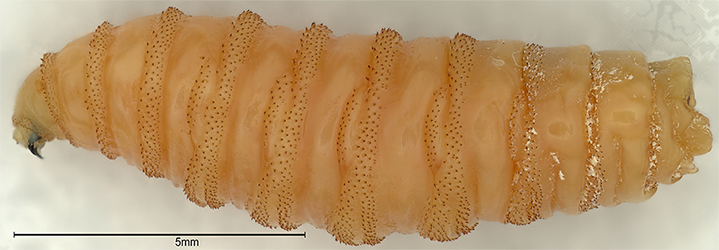
Photo Credit: Prof. Gary D. Alpert, PhD, of Northern Arizona University
What is the New World Screwworm?
- Appearance: Adult screwworm flies have large, orange eyes and are metallic blue-green in color with three distinct dark stripes along their backs. The larvae are whitish, legless maggots with a body that looks like a screw, and a dark, pointed head.
- Life Cycle: Adult female screwworm flies are attracted to open wounds on animals. They lay batches of eggs in and around the wound. Within 24 hours, the eggs hatch into maggots. These maggots burrow into the living tissue, feeding and growing for about 5-7 days. Once mature, the larvae drop to the ground and further develop in the soil. After about a week, the adult fly emerges, and the cycle begins again.
- Impact: The feeding larvae cause extensive tissue damage, leading to secondary infections, weakness, and often death of the host animal. This can have devastating impact on livestock with economic consequences for livestock producers and can impact wildlife populations. However, NWS is not a food safety issue as it only spreads when an NWS fly lays eggs in a wound. NWS is not spread through meat, poultry, or dairy products. The U.S. food supply remains safe.
Risk to Pets and Humans
While screwworm flies primarily target livestock, they can affect other warm-blooded animals, including pets and, in rare cases, humans. You are at higher risk for NWS if you live in or travel to areas where NWS flies are found, spend a lot of time outside where NWS flies are, and if you have an open wound. The current risk to animals and people in the U.S. is very low.
Current Status:
NWS is typically found in South America and parts of the Caribbean. However, since 2023, the fly has steadily moved northward from South America through Central America and Mexico. Federal and State agencies are continuously monitoring the situation.
- Current Distribution: An outbreak of NWS has moved northward through Central America and Mexico, primarily infesting livestock, pets, and wildlife, but some people have also been infected. The first animal cases in the U.S. were detected in Texas and New Mexico in June 2026. There have been no reports of humans getting infected with NWS in the U.S. Screwworms thrive in moist, warm climates with abundant vegetation and do not tolerate long periods of very dry hot or extreme cold weather. Therefore, the risk of infestation in people remains low in New York and throughout the U.S.
- Surveillance Programs: The U.S. Department of Agriculture (USDA) Animal and Plant Health Inspection Service (APHIS) maintain active surveillance programs to detect NWS flies and respond to NWS cases in animals.
- For the latest information on the current status and any detected outbreaks, visit the Centers for Disease Control and Prevention (CDC) New World Screwworm Outbreak page and the USDA New World Screwworm detection page.
Preventing Infestations in People:
Human infestation is rare but possible. It typically occurs when eggs are laid in wounds on the skin. Symptoms can include itching, burning, and the sensation of movement under the skin. You should get medical attention immediately if a screwworm infestation is suspected. In areas where there are NWS flies, take these steps to protect yourself from infestation:
- Keep open wounds clean and covered, no matter how small or where they are on the body.
- Wear loose-fitting, long-sleeved shirts and pants, hats, and socks to expose the least amount of skin.
- Use an EPA-registered insect repellent to prevent insect bites.
- Treat clothing and gear with products containing 0.5% permethrin.
- Sleep indoors with windows closed or in rooms with screens. If you are outside, sleep under a bed net or inside a screened tent.
Preventing Infestations in Pets:
Dogs, cats, and other domestic animals can be infected by screwworms if they have open wounds. Infestation can cause significant pain, tissue damage, and secondary infections. Prompt veterinary care is very important.
- Check your pet's entire body for any wounds, including tick bites.
- Immediately care for and dress any wounds, including recent surgical incisions. Keep an eye on the wounds and contact your veterinarian if anything seems abnormal. If you do see maggots, do not remove them before speaking with a veterinarian. If any maggots fall off, place them in a sealed container with rubbing alcohol to kill them. Do not throw away until you receive instructions from a veterinarian.
- Make sure your pet's environment is safe. Look for hazards like metal collars, chains, wire fences, rusty cages, and sharp plants. Prevent risky behaviors for dogs and cats, particularly those with outdoor access, such as fighting or accidents.
- Follow your veterinarian's instructions when using drugs to prevent or treat NWS infestations in animals.
Preventing Infestations in Livestock:
For information on how to prevent infestations in livestock, visit the USDA webpage on How to Reduce Risk of New World Screwworm on Livestock Operations.
Symptoms of an NWS Infestation in Humans:
Symptoms can include:
- Feeling maggots move or seeing maggots within a skin wound or sore, or in the ears, nose, eyes, or mouth.
- Painful skin wounds or sores that worsen within a few days.
- A foul-smelling odor from the site of the infestation.
- Bleeding from open sores.
Bacteria can also infect wounds where NWS maggots are present and may lead to symptoms like fever or chills.
Treatment:
If you see or feel maggots in or on a wound or other area of your body, contact your health care provider immediately. Tell them if you have recently traveled to Central or South America, the Caribbean, Mexico, or areas of the United States where NWS has been detected.
Your health care provider will need to remove each maggot, sometimes by surgery.
Do not try to remove any maggots or egg masses yourself. If maggots or eggs fall out of the wound, place them in a sealed container with rubbing alcohol to kill them. Bring them with you to your health care provider.
** Important: Do not throw any live maggots in the trash or outside. This could cause NWS to spread in your area.
For more detailed information on New World screwworm risks and prevention, visit:
- Centers for Disease Control and Prevention (CDC):
- United States Department of Agriculture Animal and Plant Health Inspection Service (USDA APHIS):
- United States Department of Agriculture Natural Resources Conservation Service:
- NYS Department of Agriculture and Markets:
- American Veterinary Medical Association:
- United States Environmental Protection Agency:
- United States Food and Drug Administration:
