Sickle Cell Disease

Out of all states, New York has the second highest number of individuals diagnosed with sickle cell disease.[1] The New York State Department of Health operates various initiatives to screen individuals for sickle cell disease and improve the care offered to New Yorkers diagnosed with sickle cell disease.
About Sickle Cell Disease
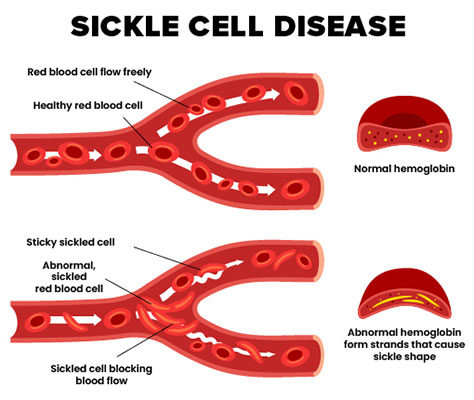
Sickle cell disease is a genetic or inherited blood disorder that affects hemoglobin, a protein that carries oxygen throughout the body. Rigid, sickle/"C" shaped red blood cells die early and can block blood flow to parts of the body. The most common types of sickle cell disease include HbSS, HbSC, and HbS beta-thalassemia.[2]
Sickle cell disease is the most common inherited blood disorder in the United States, affecting over 100,000 people across the country. People of all races and ethnicities can inherit sickle cell disease, but it is most common in New Yorkers with African or Hispanic/Latino ancestry.[3]
Sickle cell disease causes severe pain crises and may cause complications throughout the body, which include, but are not limited to, acute chest syndrome, strokes, organ damage, and more severe infections.[4] Complications from sickle cell disease can be reduced, or better managed, by attending regular check-ups, working with your doctor to create a treatment plan, and taking small, simple steps that are proven to help people with sickle cell disease. These steps include drinking plenty of water, not getting too hot or too cold, avoiding high altitudes, and reducing your exposure to harmful infections.[5]
The New York State Department of Health's fact sheet What You Should Know About: Living with Sickle Cell Disease is an informational resource for people living with sickle cell disease.
Newborn Screening
The Wadsworth Center at the New York State Department of Health provides Newborn Screening for Sickle Cell Disease and Other Hemoglobinopathies for all babies born in New York. Please note that screening is NOT a diagnosis. Further diagnostic testing is required following an abnormal screening result (see "Sickle Cell Disease Care" section, below).
Newborn screening can also identify sickle cell trait. Sickle cell trait does not usually cause complications, but it does mean that an individual may have a child with sickle cell disease if their partner is also a carrier.[6]
Find more information on sickle cell trait and helpful resources like brochures and checklists for families, please visit the Newborn Screening Program's webpage.
Sickle Cell Disease Care
The New York State Department of Health is dedicated to ensuring that adults and children with sickle cell disease have access to the treatment and support they need.
Hemoglobinopathy Specialty Care Centers across New York State are experienced in treating infants with sickle cell disease. If the New York State Department of Health’s Newborn Screening Program finds that a baby born in New York State may have sickle cell disease, they will contact both the baby's health care provider and an appropriate Hemoglobinopathy Specialty Care Center.
Find a Specialty Care Center for Newborns with Hemoglobinopathies near you.
The Bureau of Child Health at the New York State Department of Health operates a Children and Youth with Special Health Care Needs (CYSHCN) Program that seeks to improve the system of care for children and youth with special health care needs from birth and up to 21 years of age and their families, including children with sickle cell disease. New York State’s Children & Youth with Special Health Care Needs Program offers children and young people with special health care needs (like sickle cell disease) a host of supportive services and other resources. Under a joint partnership between New York State Department of Health’s Children & Youth with Special Health Care Needs Program and a New York Medicaid program called Health Homes Serving Children (HHSC), there are five (5) Hemoglobinopathy Specialty Care Centers throughout New York that administer the Sickle Cell Disease Adolescent Transition Services Program.
The Sickle Cell Disease Adolescent Transition Services Program is intended to improve outcomes for adolescents and young adults, ages 12-21, with sickle cell disease, as they transition from pediatric to adult health care and strive to achieve self-care.
In March 2022, sickle cell disease was added as a single qualifying condition for Medicaid Health Homes - Comprehensive Care Management and Health Homes Serving Children (HHSC). Individuals with sickle cell disease who receive benefits through New York’s Medicaid Program may be eligible to join a Health Home. A "Health Home" is not a physical place; it is a group of health care and service providers working together to make sure you get the care and services you need to stay healthy. Once you are enrolled in a Health Home, you will have a care manager that works with you to develop a care plan. Click here to find a Health Home.
Understand Your Rights as a Hospital Patient in New York State.
How to Get Involved
In December 2023, Governor Kathy Hochul signed legislation that requires the New York State Health Equity Council to advise the Commissioner of Health on sickle cell disease and create recommendations to promote the screening and detection of sickle cell disease. Read more about the Health Equity Council at the Office of Health Equity and Human Rights Councils and Boards webpage.
