PFAS in Household Products
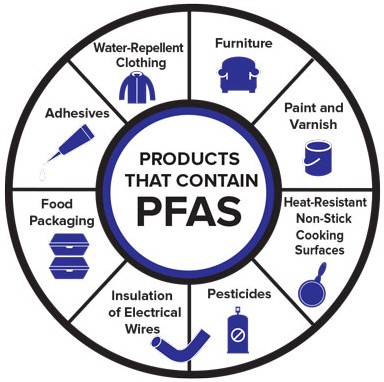
Common household stain-, oil-, and water-resistant products can contain potentially harmful levels of chemicals called per- and polyfluoroalkyl substances (PFAS). This website provides information about how to avoid PFAS from household products.
Make Better Choices
Read Labels
Products such as furniture, rugs, upholstery, bedding, raingear, and cosmetics labeled as stain- or water-resistant, waterproof, or long-lasting may contain PFAS.
- Avoid products with fluoro or fluorinated listed on ingredients. These terms usually mean they contain PFAS.
- Check the manufacturers’ website and labels and choose products labeled as PFAS-free.
- Choose products labeled with these certifications:
- BPI Compostable: Serving bowls, utensils, food storage, straws, and paper plates.
- GreenScreen Certified™: Common products covered include textiles, food packaging, electronics, and building materials.
- OEKO-TEX® STANDARD 100 / MADE IN GREEN: Common products covered include clothing, bedding, and home textiles.
- Cradle to Cradle Certified®: Common products covered include building materials, personal care, textiles, and packaging.
- ECOLOGO® Certification: Common products covered include cleaners, office supplies, and fire extinguishers.
- EPA’s Safer Choice: Common products covered include household and institutional cleaners, dish soap, and laundry detergents.
When Preparing Foods
- Avoid nonstick cookware. Instead use steel or cast-iron cookware along with cooking oil when preparing foods.
- Don’t heat foods wrapped in grease-resistant packaging.
Good Housekeeping
Dust, vacuum, and wet mop floors and surfaces regularly with water to reduce risks of breathing in PFAS-containing dust from older stain-resistant furniture and carpeting.
Household Drinking Water
PFAS has also been detected in household drinking water near where these chemicals were manufactured, used, or disposed of.
If You have a Private Well
- Use a water filter reduce your exposure to PFAS. Given the expense of testing, some people may choose this option.
- Contact your local health department or DOH’s Bureau of Environmental Exposure Investigation to find out about areas with known contamination, and available programs that may support testing and treating private well drinking water in your area.
If your water comes from a public water system
- Public water is tested and treated to reduce levels chemicals where standards are exceeded. This includes testing for the most common PFAS, PFOA and PFOS. Request a copy of your drinking water report from the public water system listed on your water bill. Large water systems list their reports at https://water.ny.gov.
Take Advantage of New York State Protections
- Buy clothing in New York State. As of January 2025, new clothing sold in the State must be free of PFAS. More restrictions will go into effect in 2028 requiring that all severe weather clothing must be PFAS free.
- Shop for food in New York State. Since December 31, 2022, all food packaging made of paper, cardboard, or any material from plants must be PFAS free. This includes pizza, and pastry boxes, sandwich wrappers, and paper cups and plates.
- New York State specifically has public drinking water standards for two of the most common PFAS, PFOA and PFOS, that are among the most protective in the country. New York is working to pass even more drinking water standards and notification levels for up to 23 PFAS. Under regulations, New York State public water suppliers must regularly monitor for these contaminants, notify health departments and the public when levels are above standards, and work with health departments to bring water systems into compliance.
Why PFAS are a Concern
Human exposure with certain PFAS may be linked to health conditions, such as:
- Higher cholesterol levels
- Vaccine resistance
- Changes in liver enzymes
- Pregnancy-induced hypertension and preeclampsia
- Kidney and testicular cancer
- Small decreases in birth weight
Public health and environmental agencies and New Yorkers have become increasingly aware of PFAS in the environment. Studies show that human exposure to PFAS is widespread and that nearly all people in the United States have some PFAS compounds in their blood.
People can be exposed by breathing in PFAS or consuming it. Some PFAS remain in the environment and in the human body for many years. However, levels go down once exposures have ended. Learn more about PFAS.
The New York State Department of Health continues to work with other state and federal agencies and researchers across the country to learn more about the complex relationship between PFAS exposure and health. Read more about New York State PFAS, Exposure and Health Projects.
