Indoor Air Quality (IAQ) Monitoring Tool Program

The NYS School Environmental Health Program (SEHP) has developed a free non-regulatory tool to grade indoor air quality using low-cost sensors- sensors are free for qualifying schools.
How Can Schools Participate?
- All schools in NYS are welcome to participate.
- Free training and tools to improve indoor air quality.
- Some schools may qualify for free air sensors.
- Email SEHP to see if your school qualifies for free sensors.
Why Does IAQ Matter?
- IAQ is a common concern in many schools due to the building’s age, condition, and ventilation system. IAQ is affected by many factors that are directly related to building operations and maintenance.
- Poor IAQ can increase allergens, worsen asthma, and promote the spread of respiratory illnesses.
- Good indoor air helps improve student and staff health and learning outcomes, decreases rates of absenteeism, and reduces asthma and allergy triggers.
- Proactive monitoring provides data that can be used to address concerns, reducing the need for more costly air quality investigations.
How the IAQ Monitoring Process Works
- Air sensors are used to measure temperature, relative humidity, carbon dioxide, and particulate matter levels. The results are then compared to season-specific indoor air comfort standards that were created by SEHP. For more information on each of the measurements, please see the IAQ infographics below.
- The Step-By-Step Guide provides instructions on how to use the sensors, interpret the results, and improve indoor air quality.
- After using the air sensors, the IAQ Calculator Tool will help evaluate the data and provide percentage-based grades for each measurement.
- A customizable IAQ Management Plan helps schools plan long-term improvements, review environmental regulations, and lists best practices that can improve indoor air quality.
IAQ Monitoring Steps
The SEHP IAQ monitoring tool program uses Airthings View Plus sensors only. For help setting up Airthings View Plus air sensors, watch this video and refer to the Step-by-Step Guide.
- Sensors are free for qualifying schools or are available for purchase online.
- It is recommended to monitor IAQ twice a year, in both the heating and cooling seasons.
- Heating Season - October 1st to March 31st.
- Cooling Season - April 1st to September 30th.
- IAQ monitoring should occur for at least 5 consecutive occupied school days.
- Schools should monitor at least 10% of all classrooms for best results.
IAQ Comfort Standards for Schools
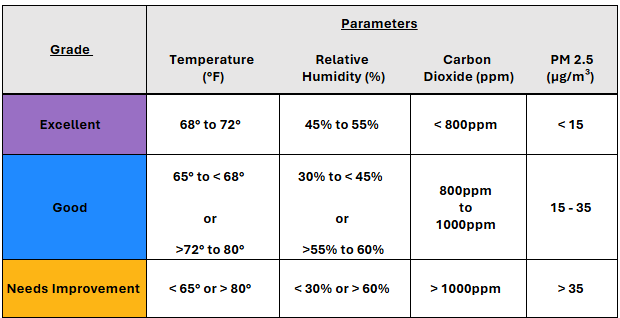
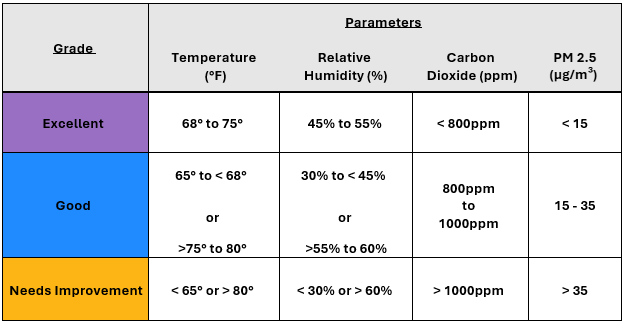
- SEHP’s standards are comfort-based, not health based. Experiencing IAQ conditions that fall in the “needs improvement” category is not a health risk for most people.
- The comfort-based standards are based on current industry standards, New York State mechanical and building codes, national and international ambient air standards, and scientific literature.
- There are no nationally recognized indoor air quality standards.
- It is typical for an indoor air environment to experience fluctuations based on room occupancy and activities.
- Different temperature standards are set for heating and cooling seasons.
Heating Season Standard - October 1st to March 31st
Cooling Season Standard - April 1st to September 30th
Best Practices
- Review Building Management System settings and functions to ensure they are running properly and make appropriate adjustments.
- Keep unit ventilators clear of classroom materials and clutter.
- Routinely dust surfaces, including HVAC vents and ceiling diffusers, with a damp cloth.
- Store food items inside pest-proof containers.
- Use green cleaning products.
- Adopt a school-wide fragrance-free policy.
- Maintain frequent communication with stakeholders regarding environmental health concerns.
- Use properly sized portable air purifiers with HEPA filters in classrooms.
- Regularly inspect and maintain HVAC and portable air purifier filters according to manufacturer’s instructions.
- Test facilities at least every five years for radon. If results are greater than or equal to 4 picoCuries per liter of air (pCi/L), install a radon mitigation system.
