New York State Medicaid Update - May 2026 Volume 42 - Number 6
In this issue …
- All Providers
- Policy and Billing
Prior Approval Changes Effective January 1, 2027
On January 17, 2024, the Centers for Medicare and Medicaid Services (CMS) released the CMS Interoperability and Prior Authorization Final Rule (CMS-0057-F). The rule requires State Medicaid programs to implement new timelines for processing prior approvals (PAs) for medical items and services. New York State (NYS) fee-for-service (FFS) was granted an implementation extension date of January 1, 2027. For additional information, providers should refer to the CMS Interoperability and How the New Rule Will Change Prior Approval, Effective January 1, 2027 document.
New PA Timelines:
- Standard PA Requests:
- Standard PA requests that fall under the medical benefit will be adjudicated within seven days from the date received, provided all necessary documentation is included. For detailed submission criteria, providers should refer to the applicable provider manual, located on the eMedNY "Provider Manuals" web page.
- NYS Medicaid may extend the PA decision timeframe by up to 14 calendar days when additional information is needed to make a determination. Failure to submit requested information within these timelines will result in a PA denial.
- Expedited PA Requests:
- PA requests can be expedited for emergent cases and will be determined no later than 72 hours after receiving the request. If it is determined that the request does not meet the definition of an expedited PA request, it will be converted to a standard request.
Electronic Provider Assisted Claim Entry System/eMedNY eXchange
Providers are encouraged to enroll in electronic Provider Assisted Claim Entry System (ePACES) and eMedNY eXchange to allow for real-time claim submission, eligibility verification, and prior approval requests. ePACES enrollment instructions are located in the eMedNY ePACES – Enrollment document. Providers must be enrolled in ePACES in order for the eXchange inbox to be activated, and the same credentials are used for both.
NYS Regulatory Changes
To align with the federal changes, NYS Department of Health will be amending Title 10 of the New York Codes Rules and Regulations §85.37, to replace the existing 21-day timeframe with the revised timelines. A notice will be posted as a Proposed Rule Making in the State Register for public comments.
Questions and Additional Information:
|top of page|
New York State Medicaid Coverage of Breast Cancer Screening, Imaging, and Testing for Management and Treatment
The New York State (NYS) Breast Cancer Screening Law, available on the NYS Department of Health "New York State Breast Cancer Screening Law" web page, requires coverage of breast cancer screening and diagnostic imaging with no out-of-pocket costs to the patient. This includes coverage of diagnostic mammograms, breast ultrasounds, and magnetic resonance imaging (MRI) when ordered by a provider in accordance with nationally recognized clinical guidelines. This article serves to outline NYS Medicaid fee-for-service (FFS), and Medicaid Managed Care (MMC) coverage of breast cancer screening and follow-up services including imaging and testing to guide management and treatment, as well as genetic testing for high-risk individuals.
Breast cancer is one of the most common cancers among females in NYS. Each year, at least 17,000 people are diagnosed with breast cancer and nearly 2,400 die from the disease making it the second leading cause of cancer-related deaths among females in NYS. An estimated one in eight females will develop breast cancer during their lifetime; it is most often found in females 50 years of age and older. Though rare, people assigned male at birth can also develop breast cancer; approximately 160 are diagnosed with breast cancer yearly in NYS. Breast cancer screening guidelines address the frequency and approach to screening for all populations, including those with a family history of breast cancer, those with dense breasts, and transgender and non-binary individuals assigned female at birth. Based on current guidelines, transgender females, on Gender-Affirming Hormone Therapy (GAHT) for five years or more are recommended to initiate screening mammography and digital breast tomosynthesis, irrespective of age, once five years of hormone therapy has been reached; screening should be repeated every two years for those at average risk of developing breast cancer. Transgender males who have not undergone chest surgery should begin screening at 40 years of age.
For detailed breast cancer screening guidelines for transgender and gender-diverse individuals, providers should consult the Cleveland Clinic Journal of Medicine "Breast cancer risk and screening for transgender and gender-diverse individuals" web page, as well as the Journal of the American College of Radiology "ACR Appropriateness Criteria® Transgender Breast Cancer Screening" web page.
Coverage of Breast Cancer Screening and Diagnostic Mammography
Mammography alone is the recommended and preferred screening modality for most people. NYS Medicaid provides coverage without cost-sharing for the following mammography services:
- A single baseline mammogram for individuals 35 to 39 years old.
- Yearly mammograms for individuals 40 years of age and older.
- Mammograms for individuals at any age who are at an increased risk of breast cancer, such as a prior history of breast cancer or having a first-degree relative (e.g., parent, sibling, child) with breast cancer, and when a clinician recommends the mammogram.
- Mammograms for individuals at any age for reasons outside of routine, annual screening, including repeat mammograms, when recommended by a clinician as per well-established standards of care and best practice guidelines.
Screening and Diagnostic Mammography May Be Billed Using the Following Current Procedural Terminology (CPT) Codes:
| CPT Code |
Description |
| 77065 |
Diagnostic mammography of one breast |
| 77066 |
Diagnostic mammography of both breasts |
| 77067 |
Screening mammography of both breasts |
Coverage of Screening Mammography with Tomosynthesis
NYS Medicaid provides coverage for recommended screening using digital breast tomosynthesis, if determined medically necessary, at no cost to the patient; payment will be made only when furnished in conjunction with 2D digital mammography. Additional information can be found in the New York State Medicaid Coverage of Digital Breast Tomosynthesis Three-dimensional Mammography article published in the August 2017 issue of the Medicaid Update.
Screening Mammography with Tomosynthesis May Be Billed Using the Following CPT Code:
| CPT Code |
Description |
| 77063 |
Breast tomosynthesis of both breasts with mammogram |
Coverage of Breast Ultrasound, MRI, and Biopsy
Additional breast cancer screening and diagnostic methods should be utilized when mammography alone is unable to adequately screen or evaluate the breast tissue.
Breast Ultrasound Imaging Guidelines
Breast ultrasound is used for screening and diagnostic evaluation, following mammography, when recommended by a clinician, per well-established standards of care and best practice guidelines. Breast ultrasound can be utilized in the evaluation of palpable or mammographically identified masses. NYS Medicaid provides coverage for recommended breast ultrasound and/or MRI for the detection and evaluation of breast cancer, if determined medically necessary, at no cost to the patient.
Following mammography, breast ultrasound may be provided for individuals under the following circumstances:
- abnormalities were found on mammogram;
- individual has dense breasts;
- symptomatic breasts with a lump or nipple discharge;
- pregnant or breastfeeding individuals;
- at higher-than-average risk for breast cancer and unable to undergo MRI;
- have breast implants that obscure the view of suspicious lumps or masses;
- have a cyst or fibroadenoma that must be monitored for changes;
- experiencing breast pain, swelling, redness, skin retraction, and/or inversion of the nipple or discharge; and/or
- identifying the ideal location for the placement of a needle or tube for the drainage of fluid or to biopsy breast tissue.
Breast MRI Screening Guidelines
Following annual mammography, an MRI of the breasts may be provided for further screening if necessary to better evaluate breast tissue under the following circumstances:
- the individual has a lifetime risk of breast cancer of 20 percent or greater, per risk assessment tools based mainly on family history;
- the individual has a known Breast cancer type 1 (BRCA1) or Breast cancer type 1 (BRCA2) gene mutation;
- the individual has a first-degree relative (e.g., parent, brother, sister, child) with a BRCA1 or BRCA2 gene mutation and has not had genetic testing themselves;
- the individual had radiation therapy to the chest before 30 years of age; and/or
- the individual has Li-Fraumeni syndrome, Cowden syndrome or Bannayan-Riley-Ruvalcaba syndrome, or has a first-degree relative with one of these syndromes.
Please note: MRI should not replace mammography but can be used in combination with mammography as a tool to enhance cancer detection.
Breast Biopsy Guidelines
Following imaging of the breasts, if a suspicious abnormality is identified, a biopsy may be deemed necessary by the clinician for further evaluation. Breast biopsy can be crucial in determining the need for further treatment.
Billing for Breast Ultrasound, Breast MRI, and Biopsy using the following CPT Codes:
| CPT Code |
Description |
| 10004 |
Fine needle aspiration biopsy, each additional growth |
| 10005 |
Fine needle aspiration biopsy using ultrasound guidance, first growth |
| 10006 |
Fine needle aspiration biopsy using ultrasound guidance, each additional growth |
| 10007 |
Fine needle aspiration biopsy using fluoroscopic guidance, first growth |
| 10008 |
Fine needle aspiration biopsy using fluoroscopic guidance, each additional growth |
| 10009 |
Fine needle aspiration biopsy of growth using Computed Tomography (CT) guidance, first growth |
| 10010 |
Fine needle aspiration biopsy of growth using CT guidance, each additional growth |
| 10011 |
Fine needle aspiration biopsy of growth using MRI guidance, first growth |
| 10012 |
Fine needle aspiration biopsy of growth using MRI guidance, each additional growth |
| 10021 |
Fine needle aspiration biopsy, first growth |
| 19081 |
Biopsy of breast and placement of locating device using x-ray with needle, first growth |
| 19082 |
Biopsy of breast and placement of locating device using x-ray with needle, each additional growth |
| 19083 |
Biopsy of breast and placement of locating device using ultrasound, first growth |
| 19084 |
Biopsy of breast and placement of locating device using ultrasound, each additional growth |
| 19085 |
Biopsy of breast and placement of locating device using MRI, first growth |
| 19086 |
Biopsy of breast and placement of locating device using MRI, each additional growth |
| 19100 |
Biopsy of breast; percutaneous, needle core, not using imaging guidance |
| 19101 |
Biopsy of breast through incision |
| 76641 |
Complete ultrasound scan of one breast |
| 76642 |
Limited ultrasound scan of one breast |
| 77046 |
MRI scan of one breast without contrast |
| 77047 |
MRI scan of both breasts without contrast |
| 77048 |
MRI scan of one breast with and without contrast |
| 77049 |
MRI scan of both breasts with and without contrast |
Coverage of Breast Cancer Testing for those at High Risk
NYS Medicaid provides coverage for recommended testing for mutations in the BRCA1 and BRCA2 genes of individuals at a higher risk for breast cancer. Such testing may be most appropriate in individuals with the following risk factors/personal history of:
- breast cancer;
- ductal carcinoma in situ (DCIS);
- exposure to high levels of radiation;
- certain kinds of breast changes including fibroadenomas, lipomas, intraductal breast papilloma, and fibrocystic breast disease;
- ovarian cancer;
- dense breasts;
- excess weight gain, especially after menopause;
- hormone replacement therapy for symptoms of menopause;
- exposure to synthetic estrogen before birth;
- longer menstrual history;
- being at an older age at the time of first birth;
- never having carried a pregnancy to term;
- never having breastfed;
- breast cancer (family history);
- alcohol consumption; and
- sedentary lifestyle, especially after menopause.
Additional information on recommended testing for mutations in the BRCA1 and BRCA2 genes of individuals at high-risk of hereditary breast cancer may be found on the National Cancer Institute "BRCA1 and BRCA2: Cancer Risks and Management (PDQ®)–Health Professional Version" web page, as well as the Changes in Personal/Familial History Criteria for Medicaid Breast Cancer (BRCA) Genetic Testing article published in the October 2015 issue of the Medicaid Update.
Regarding BRCA1 and BRCA2 mutation testing in conjunction with BRCA Large Rearrangement Test (BART) and how it must be billed under NYS Medicaid, additional information can be found in the New York State Medicaid Program – Fee-For-Service Laboratory Procedure Codes and Coverage Guidelines Manual.
Please note: In individuals without a personal history of breast or ovarian cancer and with family history only, clinical judgment should be used when determining if the individual has a reasonable likelihood of a mutation. Limitations of test result interpretation should be discussed with the individual prior to testing, as part of the informed consent and genetic counseling processes.
Testing for Mutations in the BRCA1 and BRCA2 Genes of Individuals at High Risk for Hereditary Breast Cancer Should Be Billed Using the Following CPT Codes:
| CPT Code |
Description |
| 81162 |
Gene analysis (BRCA1 and BRCA2) of full sequence and analysis for duplication or deletion variants |
| 81163 |
Gene analysis (BRCA1 and BRCA2) of full sequence |
| 81164 |
Gene analysis (BRCA1 and BRCA2) for duplication or deletion variants |
| 81165 |
Gene analysis (BRCA1) of full sequence |
| 81166 |
Gene analysis (BRCA1) for duplication or deletion variants |
| 81167 |
Gene analysis (BRCA2) for duplication or deletion variants |
| 81212 |
Gene analysis (BRCA1 and BRCA2) for 185delAG, 5385insC, 6174delT variants |
| 81215 |
Gene analysis (BRCA1) for known familial variant |
| 81216 |
Gene analysis (BRCA2) of full sequence |
| 81217 |
Gene analysis (BRCA2) for known familial variant |
| 81307 |
Gene analysis (partner and localizer of BRCA2) full sequence analysis |
| 81308 |
Gene analysis (partner and localizer of BRCA2) for detection of known familial variant |
| 81309 |
Gene analysis (partner and localizer of BRCA2) targeted sequence analysis |
Predictive/Prognostic Testing for Breast Cancer Management and Treatment
NYS Medicaid also provides coverage for recommended predictive and prognostic breast cancer assays, which include Breast Cancer Index®, MammaPrint®, Oncotype DX®, EndoPredict®, and Prosigna®.
Breast Cancer Index® is a predictive and prognostic genomic test that assists clinicians in making determinations regarding the appropriate duration of extended endocrine therapy (EET) beyond five years in individuals with hormone receptor positive (HR+), early-stage breast cancer.
MammaPrint®, Oncotype DX®, EndoPredict®, and Prosigna® are predictive and prognostic gene expression tests that assist clinicians in making determinations regarding the effective and appropriate use of chemotherapy in individuals with malignant neoplasms of the breast, when all the following criteria are met:
- test results will aid the patient and practitioner in making the decision regarding chemotherapy (i.e., when chemotherapy is a therapeutic option and is not precluded due to any other factor);
- tumor is estrogen receptor positive, progesterone receptor positive, or both;
- tumor is human epidermal growth factor receptor two negative;
- tumor is T1 or T2; and
- tumor is node-negative or one through three positive nodes.
Additional information on the recommended coverage of predictive and prognostic breast cancer assays is located in the New York State Medicaid Expansion of Prognostic Tests for Breast Cancer Treatment article published in the December 2023 issue of the Medicaid Update.
Please note: NYS Medicaid criteria for these tests are in accordance with current National Comprehensive Cancer Network guidelines.
Predictive/Prognostic Gene Analysis for Breast Cancer May Be Billed Using the Following CPT Codes:
| CPT Code |
Description |
| 81518 |
Messenger RNA gene analysis of 11 genes in breast tumor tissue |
| 81519 |
Test for detecting genes associated with breast cancer |
| 81520 |
Gene analysis of breast tumor tissue, profiling by hybrid capture of 58 genes |
| 81521 |
Gene analysis of breast tumor tissue, profiling of 70 content genes and 465 housekeeping genes |
Questions and Additional Information:
|top of page|
Childhood Vaccine Counseling
New York State (NYS) Medicaid fee-for-service (FFS), and Medicaid Managed Care (MMC) Plans reimburse providers for childhood vaccine counseling visits when provided to NYS Medicaid members under 21 years of age. Effective April 1, 2026, Current Procedural Terminology (CPT) code "90483" may be billed for vaccine counseling when a vaccine is not administered on the same date of service for NYS Medicaid members under 21 years of age. For childhood vaccine counseling provided on the same date of service as the administration of the vaccine, CPT code "99401" should continue to be billed.
| CCPT Code |
Code Description |
| 99401 |
Preventative medicine counseling and/or risk factor reduction intervention(s) provided to an individual (separate procedure).
Please note: This code is only to be used for vaccine counseling, not other preventive medicine counseling. A minimum of eight minutes is required. |
| 90483 |
Immunization counseling by physician or other qualified health care professional when immunization(s) is not administered on the same date of service, more than 10 minutes up to 20 minutes. |
Please note: Providers should refer to the fee schedules available on the eMedNY "Provider Manuals" web page, for the current reimbursement rates for the CPT codes listed above.
Reimbursement for childhood vaccine counseling may be provided:
- When vaccine counseling aligns with the childhood and adolescent immunization schedule recommended by the commissioner, utilizing generally accepted medical standards and based on recommendations of the American Academy of Pediatrics, the American Academy of Family Physicians, the American College of Obstetricians and Gynecologists, the American College of Physicians, the Advisory Committee on Immunization Practices, or other similar nationally recognized guidelines.
- When the counseling provided is documented in the medical record.
- In addition to an evaluation and management (E&M) or well-child visit code when all the criteria of the vaccine counseling visit specified in this guidance are met and documented.
- In addition to vaccine administration codes.
- In addition to all necessary components of the E&M/well-child visit.
- Whether or not a recommended vaccine is administered, or vaccine administration is billed for, during the encounter.
- As a stand-alone service when all the criteria specified in this guidance are met and documented.
- For up to six counseling visits per NYS Medicaid member, per year, when they have not received the recommended doses and do not have an appointment to receive a recommended dose.
Questions and Additional Information:
|top of page|
New York State Medicaid Reminder on Documentation and Records Retention Requirements
This article is a reminder to all New York State (NYS) Medicaid fee-for-service (FFS) and Medicaid Managed Care (MMC) providers that contemporaneous documentation supporting services or supplies provided to NYS Medicaid members, and medical necessity for such services and supplies, must be kept on file. Such documentation, which is subject to audit, must be maintained for a minimum of six years following the date of the NYS Medicaid payment, and for ten years or longer, as set forth in any applicable agreements with an MMC.
Questions and Additional Information:
|top of page|
Increase in Reimbursement for Article 28 Clinic Providers Delivering Mental Health Services
Effective January 1, 2025, the New York State (NYS) Medicaid fee-for-service (FFS) program will provide enhanced reimbursement for certain mental health services to Article 28 Hospital Outpatient Departments, freestanding Diagnostic and Treatment Centers, and Federally Qualified Health Centers that have opted into the Ambulatory Patient Group (APG) reimbursement methodology. Providers will receive a nine percent enhancement to the APG base rate utilized in calculating the line-level reimbursement for the specific mental health Common Procedure Codes (CPT) codes outlined below.
This payment enhancement aims to increase reimbursement for specific mental health services provided in Article 28 clinics, bringing them in line with the reimbursement rates for the same services offered in NYS Office of Mental Health Article 31 clinics. The goal is to align these payments to better support integrated health care and improve the quality of care for individuals with complex health needs. This approach promotes whole person care, addressing both physical and mental health in a more coordinated and comprehensive way.
The enhanced base rate utilized in the line-level payment calculation will only be utilized when an Article 28 rate code is billed in conjunction with one of the following mental health CPT codes: "90791", "90792", "90832", "90833", "90834", "90836", "90837", "90838", "90839", "90840", "90845", "90846", "90847", "90849", "90853", and "90863".
Increase in Reimbursements for Social Workers in School Based Health Centers
Effective for services on or after July 1, 2025, the NYS Department of Health will increase the NYS Medicaid reimbursement rates for Licensed Clinical Social Workers (LCSWs), Licensed Master Social Workers (LMSWs), Licensed Mental Health Counselors (LMHCs) and Licensed Marriage and Family Therapists (LMFTs) delivering care in Article 28 freestanding clinics, hospital-based outpatient clinics, and School Based Health Centers (SBHCs). Providers will receive a nine percent enhancement to the base rate utilized in calculating the line-level reimbursement for the specific mental health Common Procedure Codes (CPT) codes outlined below.
This increase is intended to improve access to mental health services for adults and children and will align LCSW, LMSW, LMHC and LMFT services provided in SBHCs and Article 28 facilities with the aforementioned NYS Medicaid FFS base rate enhancements. As LCSW, LMSW, LMHC and LMFT providers bill outside of the APG framework, these enhancements are not included in the above FFS APG base rate reimbursement increase.
The enhanced base rate utilized in the line-level payment calculation will only be utilized when an appropriate SBHC rate code, located on the NYS Department of Health "Rate Codes Carved Out of APGs" web page, is billed in conjunction with one of the following mental health CPT codes: "90791", "90792", "90832", "90833", "90834", "90836", "90837", "90838", "90839", "90840", "90845", "90846", "90847", "90849", "90853", and "90863".
Increase in Professional Fee Schedule
Effective for services on or after September 1, 2025,the NYS Department of Health increased the NYS Medicaid reimbursement rates for certain mental health services delivered by licensed practitioners. These practitioners will receive up to a 26 percent rate increase capped at 100 percent of the Medicare rate for the specific mental health CPT codes outlined below on the professional fee schedule. New professional fees for these codes have been loaded into eMedNY and were included in the October 1, 2025 Professional Fee Update and are retroactive to September 1, 2025.
The goal is to align FFS payments to licensed practitioners billing professional fee schedules with FFS payments made to OMH Article 31 mental health clinics so that mental health services are incentivized in medical settings. This better supports integrated health care and improves the quality of care for individuals with complex health needs.
The enhanced base rate utilized in the line-level payment calculation will only be utilized when an Article 28 rate code is billed in conjunction with one of the following mental health CPT codes: "90791", "90792", "90832", "90833", "90834", "90836", "90837", "90838", "90839", "90840", "90845", "90846", "90847", "90849", "90853", and "90863".
Questions and Additional Information:
|top of page|
New York State Medicaid Coverage of Basivertebral Nerve Ablation
Effective July 1, 2026, for New York State (NYS) Medicaid fee-for-service (FFS) and September 1, 2026, for Medicaid Managed Care (MMC) Plans, NYS Medicaid will cover basivertebral nerve ablation (BVNA) under Current Procedural Terminology (CPT) codes "64628" and "64629" for the treatment of chronic lower back pain when nonsurgical management such as but not limited to pharmacotherapy, injection therapy or physical therapy have failed to provide adequate pain control.
BVNA is a minimally invasive procedure that can be used to treat chronic, vertebrogenic back pain by destroying branches of the basivertebral nerve within a vertebral body. Current coverage of BVNA is limited to the vertebral bodies from L3 to S1. Up to four vertebral bodies may be treated in the lifetime of the NYS Medicaid member. Repeat procedures at the same vertebral body level are not considered medically necessary. Providers should follow well-established practice guidelines consistent with current standards of care and, where available, evidence-based practices, complying with recommendations of professional clinical specialty organizations regarding contraindications and clinical consideration in patient selection for BVNA. Billing providers should document use is consistent with current published guidelines.
NYS Medicaid reimbursement for BVNA is available for NYS Medicaid members, 18 years of age and older, meeting all the following criteria that must be documented in the medical record of the NYS Medicaid member:
- skeletal maturity;
- chronic lower back pain for at least six months, with lower back pain as the dominant symptom;
- evidence of Type 1 or Type 2 Modic changes on MRI [endplate hypointensity (Type1) or hyperintensity (Type 2) on T1 images plus hyperintensity on T2 images (Type1) involving the endplates between L3 and S1];
- chronic lower back pain where non-surgical management either failed to provide adequate improvement, was contraindicated or unavailable for the following modalities:
- avoidance of activities that aggravate pain,
- course of physical therapy or professionally directed therapeutic exercise program,
- cognitive behavioral therapy,
- pharmacotherapy, that may include analgesics and muscle relaxants, and
- injection therapy in the region of concern
- absence of additional vertebral pathology by physical, history, radiologic or clinical assessment including, but not limited to, fracture, tumor, infection, deformity, trauma or post-surgical change, which could cause the symptoms of the patent, or complicate the procedure and outcome; and
- physical and psychological assessment of the patient to tolerate and benefit from BVNA.
NYS Medicaid FFS Billing:
| CPT Code |
Description |
| 64628 |
Heat destruction of intraosseous basivertebral nerve in bones of spine in lower back, first two bones, lumbar or sacral |
| 64629 |
Heat destruction of intraosseous basivertebral nerve in additional bone of spine in lower back, lumbar or sacral |
Please note: Providers should refer to the fee schedules available on the eMedNY "Provider Manuals" web page, for the current reimbursement rates for the CPT codes listed above.
CPT codes "64628" and "64629" are inclusive of all imaging guidance utilized during BVNA procedures. If more than two vertebral bodies are treated on the same date of service, both CPT codes "64628" and "64629" should be listed on the claim.
Questions and Additional Information:
|top of page|
Reminder: Medicaid Attestation Required for New York State Medicaid Members Enrolled in Qualifying Clinical Trials
In December 2021, the Centers for Medicare and Medicaid Services (CMS) issued the UPDATED: Mandatory Medicaid Coverage of Routine Patient Costs Furnished in Connection with Participation in Qualifying Clinical Trials guidance, to state programs requiring coverage of routine costs associated with qualifying clinical trials. To comply with CMS directive, the New York State (NYS) Department of Health shared the mandate and instructions in the New Attestation Form for New York State Medicaid Members Enrolled in Qualifying Clinical Trials article published in the July 2022 issue of the Medicaid Update.
Practitioners are reminded that the Medicaid Attestation Form On The Appropriateness Of The Qualified Clinical Trial, must be submitted for each NYS Medicaid member enrolled in a qualifying clinical trial for whom NYS Medicaid reimbursement is requested. The Medicaid Attestation Form On The Appropriateness Of The Qualified Clinical Trial must be completed and submitted prior to providing treatment in the trial.
For each clinical trial participant who is enrolled in either NYS Medicaid fee-for-service or Medicaid Managed Care, the fully completed Medicaid Attestation Form On The Appropriateness Of The Qualified Clinical Trial must be:
- submitted with the accurate clinical trial participant name and client identification number/NYS Medicaid number;
- signed by the Principal Investigator of the clinical trial;
- signed by the treating health care practitioner of the NYS Medicaid member; and
- submitted via the Secure File Transfer application within the Health Commerce System:
- HCS Recipient: Medicaid Clinical Trial
Upon receipt of the completed Medicaid Attestation Form On The Appropriateness Of The Qualified Clinical Trial, the NYS Department of Health will review it and issue a coverage determination within 72 hours of electronic submission. The submitter will be notified of this determination electronically within the same 72-hour timeframe. Practitioners are advised to maintain appropriate documentation to support NYS Medicaid reimbursement for all services. Additional information regarding maintaining appropriate documentation, providers should refer to the New York Codes, Rules and Regulations "Section 540.7 - Requirements for billing" web page.
Questions and Additional Information:
|top of page|
Billing for Services Provided to the Office of Mental Health Residential Treatment Facility Residents
Effective July 1, 2026, New York State (NYS) Medicaid-covered services provided to NYS residents admitted to Residential Treatment Facilities (RTFs) will be discretely billable to NYS Medicaid fee-for-service (FFS) by the provider of the service, with the exception of occupational therapy (OT) and speech therapy (ST). OT and ST for NYS residents while admitted to the RTF will continue to be reimbursed to the RTF under their per diem rate code.
This expands the list of NYS Medicaid FFS reimbursable services prior to July 1, 2026, which was limited to:
- hospitals other than RTFs for payment for inpatient services;
- hospitals other than RTFs for payment for emergency services and for outpatient services provided as an alternative to hospitalization for medical care other than psychiatric care;
- vendors who supply prosthetic or orthotic appliances and devices including hearing aids for payment for such appliances or devices in accordance with the established requirements of the Medical Assistance Program; and
- prescription and physician ordered non-prescription drugs and medical supplies.
Please note: The cost of all covered services provided to the youth before the determination of NYS Medicaid eligibility will be the responsibility of the RTF and considered an allowable cost in the development of the provider reimbursement rate for NYS Medicaid RTF stays.
|top of page|
New York State Medicaid Evidence Based Benefit Review Advisory Committee to Review AI-Enabled Devices for Diabetic Retinopathy Screening
The New York State (NYS) Medicaid Evidence Based Benefit Review Advisory Committee (EBBRAC) will convene a meeting on Thursday, July 23, 2026, from 10:30 a.m. to 3:30 p.m. (ET). The primary focus of this meeting will be the review of "AI-Enabled Devices for Autonomous Screening for Diabetic Retinopathy." The meeting will take place at Empire State Plaza, Concourse Meeting Room 6, in Albany, New York.
Established in 2015, NYS Medicaid EBBRAC operates under Chapter 57, Part B, §46-a of the Laws of 2015, as Social Services Law §365-d. The purpose of the NYS Medicaid EBBRAC is to provide recommendations to the NYS Department of Health concerning NYS Medicaid coverage for health technologies and services.
This upcoming meeting follows the first 2026 NYS Medicaid EBBRAC session, held on Friday, April 17, 2026, where the committee reviewed "Acupuncture for Treatment of Nonspecific Chronic Low Back Pain in Adults."
Public Participation
The public is welcome to present on this topic at the meeting. Those interested in addressing the NYS Medicaid EBBRAC during the public presentation period must notify the NYS Department of Health by Friday, July 17, 2026. Requests can be submitted via email to EBBRAC@health.ny.gov, with "EBBRAC Speaker Request" in the subject line. Additionally, interested parties must complete the Evidence Based Benefit Review Advisory Committee Public Presentation Registration Form.
Additional Information
|top of page|
New York State Medicaid Prescriber Education Program: Free 1.5 Hour Continuing Education on Antibiotic Stewardship
A new on-demand continuing education activity is available through the New York State (NYS) Medicaid Prescriber Education Program (MPEP) titled Dental Antibiotic Stewardship: Prescribing for Prophylaxis and Intraoral Pain and Swelling. This activity is intended to help health care professionals navigate the evolving recommendations for antibiotic use related to oral health care. It focuses on antibiotic prophylaxis for infective endocarditis and prosthetic joint infection, and the urgent management of intraoral pain and swelling.
Additional Information
Practitioners should refer to the NYS MPEP Educational Library website to learn more and register for continuing education credit today.
|top of page|
New Electronic Remit Regeneration Requests on the eMedNY Website
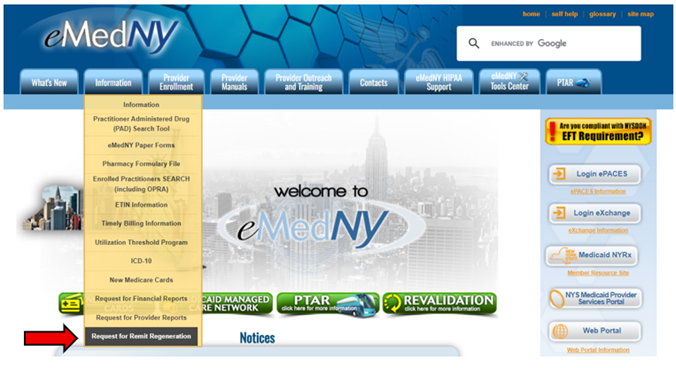
A new online form is available on the eMedNY website to request the regeneration of a previously sent electronic or Portable Document Format remittance statement. The form is located under the "Information" tab drop-down, under "Request for Remit Regeneration".
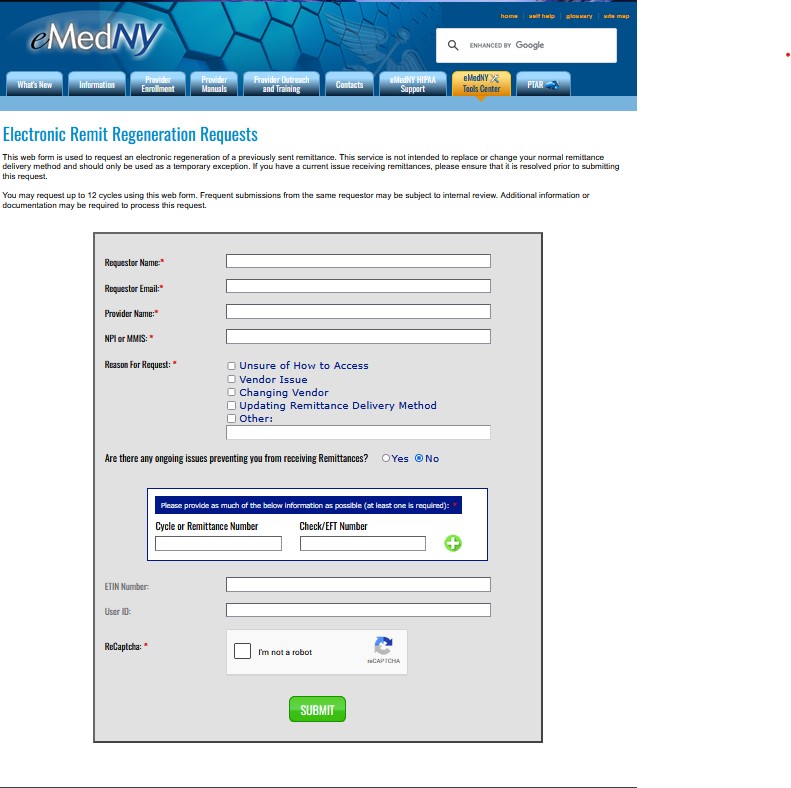
This new service is not intended to replace or change normal remittance delivery method and should only be used as a temporary exception. Providers who have an issue receiving remittances must ensure that it is resolved prior to submitting this request.
Providers should request up to 12 cycles using the form. Frequent submissions from the same requestor may be subject to internal review. Additional information or documentation may be required to process this request.
Questions
Questions regarding electronic remit regeneration requests should be directed to the eMedNY Call Center at (800) 343-9000.
|top of page|
The Medicaid Update is a monthly publication of the New York State Department of Health.
Kathy Hochul
Governor
State of New York
James McDonald, M.D., M.P.H.
Commissioner
New York State Department of Health
Amir Bassiri
Medicaid Director
Office of Health Insurance Programs
