Health Equity

Information about New York Rights and Resources for Transgender, Nonbinary, Gender Nonconforming, and Intersex People
The New York State Department of Health remains committed to carrying out its mission to protect and promote health and well-being of all, and reminding New Yorkers of important rights and resources.
New York has strong protections in place to ensure that you receive care and treatment without discrimination, regardless of your transgender or intersex status or your gender identity or expression. All New Yorkers have a right to health care services free of discrimination.
Continuity of Care Requirement:
Know Your Rights:
How to File a Complaint:
- New York State Division of Human Rights
- New York State Department of Financial Services, the state agency that regulates health insurance plans
Mental Health Crisis Support:
- 988 Lifeline - Call or text the number "988" to be connected instantly to a trained crisis counselor 24/7
- Never Use Alone - The U.S. National Overdose Response Line: 877-696-1996
Find Your Elected Official
What is Health Equity?
Health equity means everyone has a fair and just opportunity to be healthy.
At the New York State Department of Health, health equity means everyone has a fair and just opportunity to be healthy, where no one is limited in achieving optimal health because of who they are or where they live.
Read the New York State Department of Health's Health Equity Plan.
What are Health Disparities?
Health disparities refer to measurable differences in the burden of disease, injury, violence, or opportunities to achieve optimal health between population groups.1 Health disparities may lead to differences in health outcomes that are avoidable, unfair, and unjust.
What are Social Determinants of Health?
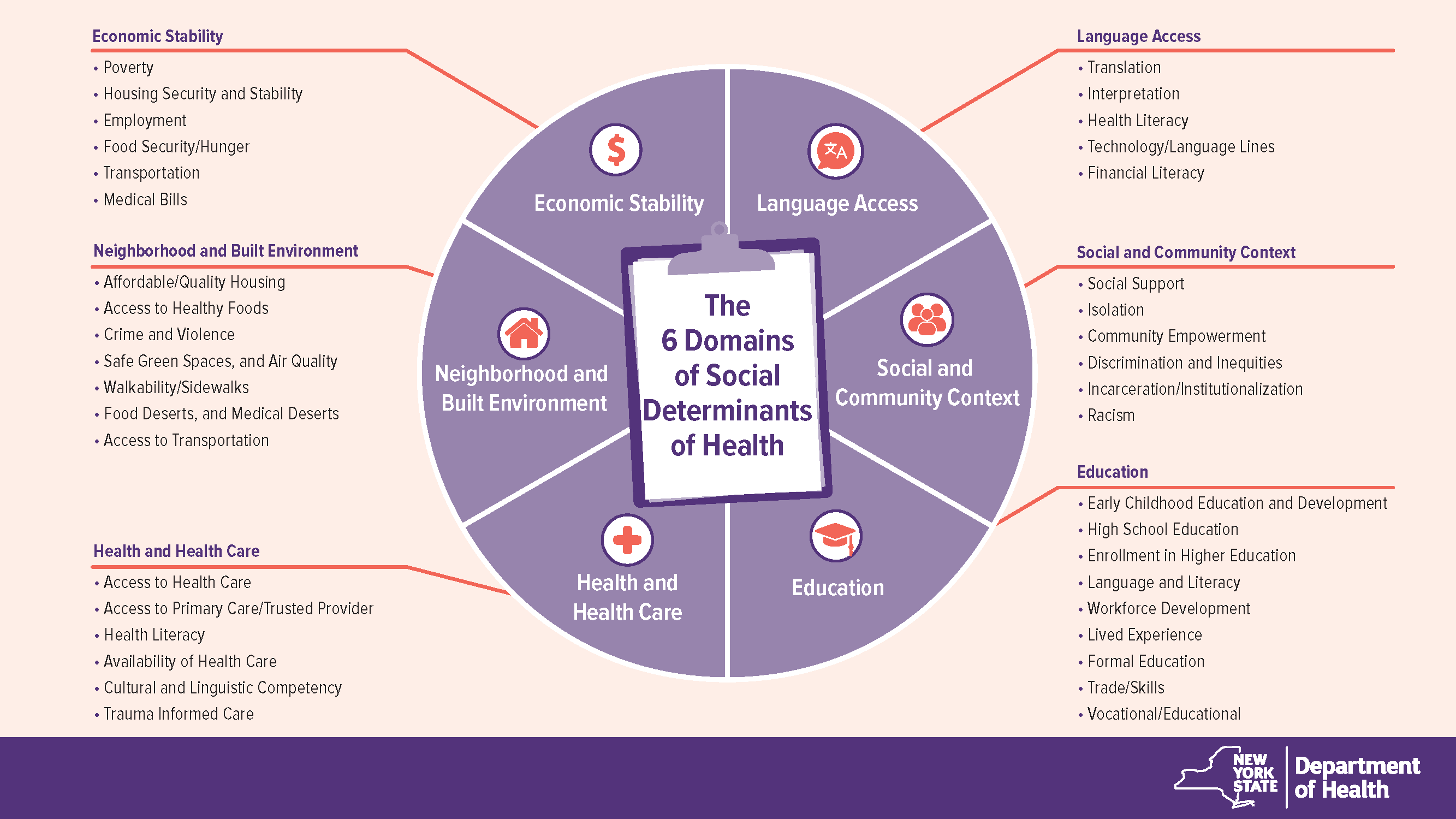
Click to see a text version of the image above
The 6 Domains of Social Determinants of Health
Economic Stability
- Poverty
- Housing Security and Stability
- Employment
- Food Security/Hunger
- Transportation
- Medical Bills
Neighborhood and Built Environment
- Affordable/Quality Housing
- Access to Healthy Foods
- Crime and Violence
- Safe Green Spaces, and Air Quality
- Walkability/Sidewalks
- Food Deserts, and Medical Deserts
- Access to Transportation
Health and Health Care
- Access to Health Care
- Access to Primary Care/Trusted Provider
- Health Literacy
- Availability of Health Care
- Cultural and Linguistic Competency
- Trauma Informed Care
Language Access
- Translation
- Interpretation
- Health Literacy
- Technology/Language Lines
- Financial Literacy
Social and Community Context
- Social Support
- Isolation
- Community Empowerment
- Discrimination and Inequities
- Incarceration/Institutionalization
- Racism
Education
- Early Childhood Education and Development
- High School Education
- Enrollment in Higher Education
- Language and Literacy
- Workforce Development
- Lived Experience
- Formal Education
- Trade/Skills
- Vocational/Educational
Social determinants of health is a term used to describe the different conditions in a person's life that can influence their ability to be as healthy as they can be. Some of the conditions in a person's life that influence their ability to achieve optimal health are:
- Access to safe and secure housing;
- Living wages, secure employment, and safe working conditions;
- Access to quality education;
- Access to quality health care services;
- Access to affordable and nutritious food;
- Freedom from racism, homophobia, transphobia, sexism, ableism, and other forms of discrimination;
- Access to social support networks;
- Access to transportation;
- Access to safe green spaces, and;
- Access to clean air and water; community is free from environmental hazards.
While many people assume that health is a product of genes and individual behaviors, research has shown that may be only 20% of what impacts individual health. The social determinants of health (or conditions in life that are necessary for achieving optimal health) listed above may be more important.[2]
It is not an accident that not all people have equal access to the social determinants of health or conditions in life that are necessary for achieving optimal health. The disparities in access to social determinants of health are the result of decades of structural and interpersonal discrimination, the legacy of which persist to the present day.
Prevention Agenda
New York has a blueprint in place for state and local action to improve the health and well-being of all New Yorkers and to promote health equity in all populations who experience disparities, called the Prevention Agenda. Learn more about New York's Prevention Agenda.
New York State Health Equity Reports
To address health disparities, we must first be able to identify and measure them. Having good data is critical to these efforts. The New York State Department of Health issues New York State Health Equity Reports with state and county level data on health disparities on an annual basis.
Read the latest and archived New York State Health Equity Reports.
References
- "Health Disparities", Center for Disease Control and Prevention, May 26 2023.
- Hoyert DL. Maternal mortality rates in the United States, 2021. NCHS Health E-Stats. 2023.
DOI: https://dx.doi.org/10.15620/cdc:124678.CDC - The New York State Report of Pregnancy-Associated Deaths in 2018
- Greer ML, Garza MY, Sample S, Bhattacharyya S. "Social Determinants of Health Data Quality at Different Levels of Geographic Detail." Studies in Health Technology and Informatics, PubMed, May 18, 2023.
