Sports-Related Protection for Children and Teens
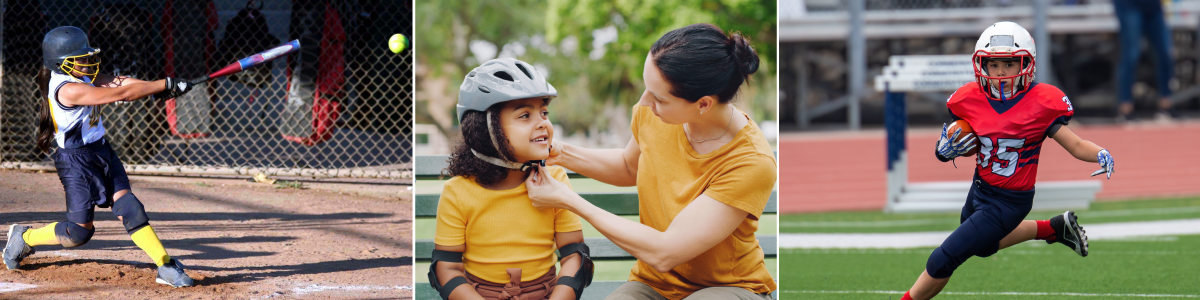
Keep your child safe from eye, mouth, and head injuries during sports.
Eye Injuries in Sports
Be aware that individual sports have different levels of risk for eye injury:
- High risk: Baseball, basketball, fencing, hockey, lacrosse, racquet sports, and softball
- Moderate risk: Badminton, football, golf, soccer, tennis, and volleyball
- Low risk: Bicycling, diving, gymnastics, skiing, swimming, track and field, and wrestling
Eye Protection Tips
- The American Academy of Pediatrics and the American Academy of Ophthalmology strongly recommend that all individuals who participate in a sport where there is a risk of eye injury wear protective eyewear.
- Wear protective eyewear with polycarbonate lenses (a strong, shatterproof, lightweight plastic) for sports such as basketball, racquet sports, soccer, field hockey, and women's lacrosse.
- Wear a helmet with a polycarbonate face mask or wire shield at all times for baseball and softball while batting, ice hockey, men's lacrosse, and women's lacrosse while playing goalie.
- Choose eye protectors that have been tested to meet the American Society of Testing and Materials (ASTM) standards.
- Regular eyeglasses do not provide adequate protection from eye injury while playing sports.
- If your child has functionally lost the use of one eye, make sure they wear appropriate eye protection such as safety glasses to protect their other eye during all sports and recreational activities.
- If your child sustains an eye injury, seek medical attention immediately. In an emergency, call 911.
Mouth Injuries
- Mouthguards help cushion a blow to the face, minimizing the risk of broken teeth and injuries to the soft tissues of the mouth.
- The American Dental Association recommends that anyone who participates in a sport with a significant risk of mouth injury wear a mouth guard.
- Sports with increased risk of mouth injury include baseball, basketball, field hockey, football, gymnastics, ice hockey, lacrosse, softball, and volleyball.
- Athletes must wear mouthguards for field hockey, football, ice hockey, and lacrosse.
- Always wear a mouthguard during practice sessions as well as during games.
- Make sure your child does not chew on or cut pieces off their mouthguard because this will decrease its effectiveness.
Mouthguards
- When choosing a mouthguard, make sure it is tear resistant, fits properly and comfortably, is easy to clean, and does not restrict breathing or speech.
- Custom-fitted mouthguards can be made by a dentist and provide the most protection but are the most expensive option.
- Follow directions on mouthguard packaging or instructions provided by your dentist.
- Replace the mouthguard if it has become thin, torn, or frayed.
Head Injuries
A traumatic brain injury (TBI or concussion) is an injury to the brain or skull caused by an external force, such as a strike or impact. When the head hits the ground or an object, the brain crashes against the skull, bruising and damaging delicate brain tissue. TBIs can result in lifelong changes in the way you think, act, feel, and move. Wearing a helmet absorbs the shock of the impact and can protect your brain and skull.
Concussions can happen in any sport. The Academy of Orthopaedic Surgeons (AAOS) advises that all athletes, no matter what their age or skill level, wear a helmet whenever their head could be injured.
How to Choose the Right Helmet
- Make sure your child wears a helmet appropriate for their sport or activity. Using the wrong helmet may interfere with balance and vision, causing a fall.
- Choose a helmet that meets the Consumer Product Safety Commission (CPSC) helmet standard. Each helmet meeting this standard should display a CPSC sticker.
- Multi-sport helmets, which offer more protection to the back of the head, can be used for a variety of sports.
- A bicycle helmet can be worn while bicycling, roller and in-line skating, and scooter riding.
- Buy a helmet than fits your child, not one that your child will "grow into."
Sports Helmet Safety Tips
- Remember that you are your child's best role model. Children whose caregivers wear their helmets are more likely to wear their helmets.
- Choose a helmet that provides a snug, comfortable fit.
- Children under age 12 should wear a winter sports helmet when sledding.
- Everyone should wear helmets while skiing or snowboarding.
- Ensure your child wears a helmet the entire time when participating in sports.
Bicycle & Wheel Sport Helmet Safety Tips
- New York State law requires children under the age of 14 to wear a helmet while using bicycles, in-line skates, skateboards, and nonmotorized scooters. Parents and caregivers could face a $50 fine if their child is riding without a helmet.
- Replace a helmet that has been involved in any impact, crash, or hard drops. The shock-absorbing materials on the inside of the helmet could be damaged.
- Never let your child wear a helmet while playing on a playground. There is a risk of strangulation from the chinstrap if the helmet gets caught on playground equipment.
Proper Bicycle Helmet Fitting
Helmets are often labeled by age or head measurement, but these are only guidelines. Children's heads are many different sizes and shapes, so they must try the helmet on and make adjustments to ensure it fits properly. Routinely check to make sure the helmet fits properly as children age and hair styles change.
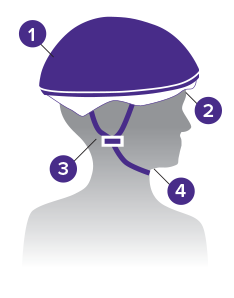
- Helmets should fit snuggly, and be level and stable on your head.
- Helmets should fit two finger widths above your eyebrow.
- Straps should form a ‘V’ under each earlobe, prior to buckling them.
- Straps should be tightened to allow no more than two fingers between the strap and your chin.
