Outreach Project with Burmese and Karen Anglers

Developing Culturally Appropriate Materials for Newcomer Communities
Fishing and eating fish are an important part of some cultures. However, newcomers are often less aware of the historical contamination in New York State waterways. Anglers cannot see, taste, or smell the chemicals that may be in locally-caught fish.
The advice for eating the fish you catch has also become more complicated. In 2024, the New York State Department of Health statewide advice changed from eating four meals a month of any locally-caught fish to different advice for each fish species. The Department continues to issue waterbody-specific advice for fish in waters with higher levels of chemical contaminants. The complexity of the new advice presents challenges for low literacy audiences and English-as-a-new-language speakers.
The Department has prioritized outreach with some of the communities that eat significant amounts of fish. The goal was to develop culturally appropriate fish advisory materials based on community needs and feedback.
Focus Groups with Vulnerable Populations
The Department made connections with community partners who work with refugees and new arrivals. In 2022 and 2023, the Department held multiple focus groups in Albany, Syracuse, and Buffalo with Karen, Karenni, Burmese, and Rohingya anglers. The Department received feedback from the community and learned more about community needs and cultural practices.
Focus groups were asked what they like about fishing and eating fish, which local waterbodies they fish the most, what fish they are eating, and how they prepare the fish. Participants looked at maps and map guides to discuss what was helpful or confusing. They shared which fishing areas they recognized from pictures and popular fishing spots that were missing from draft materials. Participants also tested the usability of the map and advice.
Focus group discussions reinforced the need for positive messaging around safe options for eating locally-caught fish. Simple language was needed to accommodate large variations in literacy. Participants also preferred family-based advice (sensitive population advice).
Audience-Informed Advice
In-depth conversation with community members allowed Department staff to develop custom-tailored materials. The process was iterative. The Department tested draft guides during focus group meetings and adjusted the guides based on feedback. Updated guides were tested again at additional focus group meetings until a design worked for most people.
The new guides incorporate health information that is simplified and written in an accessible way. A numbered map in each guide helps anglers orient and understand access points for local waters. Each waterbody on the map is paired with a recognizable picture of the access point. Waters on the map are also color coded by advisory type. Anglers are encouraged to fish from “blue” and “purple”-outlined waters where traditional cooking methods can be used. For this population, traditional cooking methods include eating whole fish with skin and fat, making soups and stews, and using locally-caught fish to make fish paste. The guides also include the by-fish approach, which provides clear fish pictures and helps improve identification skills.
Focus group participants practiced using the guides with real life examples to make sure the guides were usable and most participants were able to navigate the new guides and by-fish approach. The new adaptations are promising for this audience and could be adapted for other populations. The Department developed additional products based on community recommendations. These include “read-aloud” videos, webpages in the participants’ native languages, and social media outreach.
-
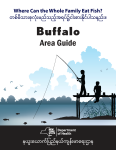
Buffalo Area Guide: Where Can the Whole Family Eat Fish? (36 pages)
This brochure provides health advice on eating fish caught from Buffalo area waters. It provides advice for the sensitive population (people who can become pregnant (under age 50) and children under 15) and for the general population (everyone else). It includes a map showing health advisories.
Available in Burmese (#6802) and Karen (#6804).
-
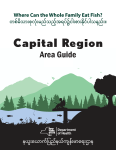
Capital Region Area Guide: Where Can the Whole Family Eat Fish? (36 pages)
This brochure provides health advice on eating fish caught from Capital Region waters. It provides advice for the sensitive population (people who can become pregnant (under age 50) and children under 15) and for the general population (everyone else). It includes a map showing health advisories.
Available in Burmese (#6798) and Karen (#6805).
-
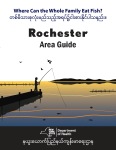
Rochester Area Guide: Where Can the Whole Family Eat Fish? (40 pages)
This brochure provides health advice on eating fish caught from Rochester area waters. It provides advice for the sensitive population (people who can become pregnant (under age 50) and children under 15) and for the general population (everyone else). It includes a map showing health advisories.
Available in Burmese (#6801) and Karen (#6803).
-
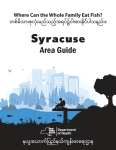
Syracuse Area Guide: Where Can the Whole Family Eat Fish? (40 pages)
This brochure provides health advice on eating fish caught from Syracuse area waters. It provides advice for the sensitive population (people who can become pregnant (under age 50) and children under 15) and for the general population (everyone else). It includes a map showing health advisories.
Available in Burmese (#6800) and Karen (#6807).
-
Utica Area Guide: Where Can the Whole Family Eat Fish? (36 pages)
This brochure provides health advice on eating fish caught from Utica area waters. It provides advice for the sensitive population (people who can become pregnant (under age 50) and children under 15) and for the general population (everyone else). It includes a map showing health advisories.
Available in Burmese (#6799) and Karen (#6806).
Burmese and Karen Guides
"Read aloud" companion videos can be viewed here:
To order printed copies of these guides, view order form here (see bottom of order form).
